Homs Opposition: Al Farouq Battalion is Killing Us Sunday, May 13 2012 


By Sharmine Narwani

It is extremely rare to have a direct peephole into events on the ground in Syria. The hard-fought battle over narratives often leaves truth in the dust. But among the cache of recently leaked emails (exclusive to Al Akhbar) from Syrian National Council (SNC) President Burhan Ghalioun’s inbox, comes this gem – important information that further highlights the glaring loophole in UN Envoy Kofi Annan’s demilitarization plans for Syria: rogue fighters.

The email sent to Ghalioun on March 25 summarizes a meeting held by members of various armed opposition groups operating in Homs – chiefly to address the pressing problem of the rogue al-Farouq Battalion.

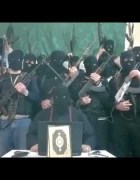
The email’s author “Abu Majd” claims that 24 different armed groups in Homs started to work together in part because of the behavior of the Farouq Battalion, some of whose members are shown in this video from a few days ago. The problem with al-Farouq, says the email, is:

“Its monopoly over decision-making in its areas, its attempts to subjugate whoever is outside its command by force, and adopting what they call a “big stick policy” in dealing with other fighters.”

Confirming occasional Arab media accounts of fighters turning on each other inside opposition-dominated neighborhoods, Abu Majd accuses the Farouq Battalion of:

Unjustified violence against their adversaries and other anti-regime groups that are not subsumed under the rubric of al-Farouq Battalion resulting in a heavy human toll. For example, al-Farouq’s mild punishment/warning to fighters in Bab al-Sibaa led to the death of five martyrs.

One wonders how these deaths were characterized in the daily “casualty counts” disseminated by Homs activists and reported widely by foreign media. (more…)

Syrian Snaphot: A View From The Capital Wednesday, Jan 25 2012 

By Sharmine Narwani

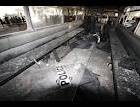
Aftermath of the Midan bombing that left 26 dead and dozens more wounded

January 2012:

Crossing over the Lebanese border into Syria was anticlimactic. The lines of people waiting to have their papers checked did not look markedly shorter than during my two previous visits, both having taken place well before popular Arab revolts broke out across the Middle East.

Even security checks — looking into the trunk of our car and the kinds of questions asked by immigration personnel — appeared, if anything, less probing than my earlier experiences.

But two things caught my notice. Posters vilifying certain media networks — Al Jazeera, Saudi-owned Al Arabiya, and the BBC — dotted the walls of the border crossing. One to the right of the counter for “foreigners” hovered over the head of the Canadian Broadcasting Corporation (CBC) crew in line in front of me. Ah, I thought — the rumors that foreign journalists are now trickling into Syria may be accurate.

The second noteworthy detail was the whispers among border personnel that a busload of Syrian soldiers being transported from their barracks had been bombed by a roadside IED — near Zabadani, a town now claimed by the armed opposition. I have no confirmation of this.

I was worried about my stay in Damascus in the Christian quarter of the Old City. Just four days earlier, on a Friday, a suicide bomber had detonated explosives in a crowded area in Midan — inside the capital — apparently targeting a bus of policemen, although the casualties were mostly civilians.

I was keen to see if there were tangible ramifications of this act of terror in the heart of Damascus — 10 months into the protests, the city is still largely viewed as being supportive of the government. Damascus counts. No uprising will be complete unless this city of 2.6 million shifts that balance. The capitol will eventually have to be a battlefield for any revolt to succeed, even if only a political one.

Syria is icy cold this time of year, which may account for some of the empty streets that are normally bustling with humanity. But the Friday after the suicide bombing, the streets were noticeably devoid of people, cars were minimal — the city, quiet. Friday, the Muslim day of prayer, is usually spent with family, so it wasn’t altogether clear if the stillness was due to the previous week’s violence.

Syrian President Bashar al-Assad’s voice greeted us on the radio as my friend and I drove into the country a few days earlier. He was delivering his fifth speech since protests broke out in March last year. It was long-winded and my companion translated every so often. I waited impatiently for these tidbits which lasted well after we were sipping tea in a Damascus hotel lobby — guests and conference attendees crowding around the TV screens to pass their judgments.

Later that day I met with the first on my list of regime opponents, most of whom had served prison terms at some point in their lives. I will write in more detail about these men and women later, but they varied from those who desired an overhaul of the regime while keeping Assad’s presidency intact, to those who would not consider dialogue with any part of the existing government. There were some commonalities. All rejected any foreign military intervention and the militarization of the protests. The majority were scathing about the Free Syrian Army (FSA) and external opposition groups like the Syrian National Council (SNC), so liberally quoted by the Western media as the definitive voice of the Syrian “opposition.”

“Their decisions are made in America and Turkey,” said one regime critic about the foreign-based Syrian opposition. “I want decisions made in Syria.” (more…)

Stratfor Challenges Narratives on Syria Tuesday, Dec 20 2011 

By Sharmine Narwani


Since the first public protests broke out in Syria last March, the narratives about the Syrian crisis have stayed fairly true to the theme of all the Arab Revolts. An authoritarian ruler out to crush peaceful opposition to his regime opens fire on civilians and the number of protestors skyrockets as the body count mounts…

But we are now entering the tenth month of this particular violent revolt – even Libya with its full-fledged civil war didn’t take so long. So what gives?

According to the Texas-based geopolitical risk analysis group Stratfor which released an eyebrow-raising piece on Syrian opposition propaganda efforts last week, “most of the opposition’s more serious claims have turned out to be grossly exaggerated or simply untrue, thereby revealing more about the opposition’s weaknesses than the level of instability inside the Syrian regime.”

This is important for two reasons. Firstly, it may be the first time a mainstream US-based intelligence-gathering firm openly questions the existing narrative on Syria. Secondly, Stratfor’s findings begs the question: what are we basing our policy initiatives on if our underlying assumptions are inaccurate?

How unstable is Syria, really? How widespread is opposition to the regime of Bashar al-Assad? The death-toll that has us riveted with disgust – today, the highest daily death rate yet – how accurate are those numbers? Who do they include and are they verifiable? Are local activists even capable of distinguishing between a dead pro-regime civilian and a dead anti-regime civilian – especially now that both sides are armed and firing?

I cannot begin to dispute those numbers and details, so I will not try. But I will ask the question: where are all the “facts” coming from? (more…)

Follow

Get every new post delivered to your Inbox.

Join 3,573 other followers