Homs Opposition: Al Farouq Battalion is Killing Us Sunday, May 13 2012 


By Sharmine Narwani

It is extremely rare to have a direct peephole into events on the ground in Syria. The hard-fought battle over narratives often leaves truth in the dust. But among the cache of recently leaked emails (exclusive to Al Akhbar) from Syrian National Council (SNC) President Burhan Ghalioun’s inbox, comes this gem – important information that further highlights the glaring loophole in UN Envoy Kofi Annan’s demilitarization plans for Syria: rogue fighters.

The email sent to Ghalioun on March 25 summarizes a meeting held by members of various armed opposition groups operating in Homs – chiefly to address the pressing problem of the rogue al-Farouq Battalion.

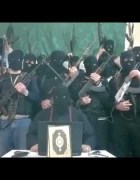
The email’s author “Abu Majd” claims that 24 different armed groups in Homs started to work together in part because of the behavior of the Farouq Battalion, some of whose members are shown in this video from a few days ago. The problem with al-Farouq, says the email, is:

“Its monopoly over decision-making in its areas, its attempts to subjugate whoever is outside its command by force, and adopting what they call a “big stick policy” in dealing with other fighters.”

Confirming occasional Arab media accounts of fighters turning on each other inside opposition-dominated neighborhoods, Abu Majd accuses the Farouq Battalion of:

Unjustified violence against their adversaries and other anti-regime groups that are not subsumed under the rubric of al-Farouq Battalion resulting in a heavy human toll. For example, al-Farouq’s mild punishment/warning to fighters in Bab al-Sibaa led to the death of five martyrs.

One wonders how these deaths were characterized in the daily “casualty counts” disseminated by Homs activists and reported widely by foreign media. (more…)

The UN Protocol’s Jihadist “Loophole” Thursday, May 10 2012 


By Sharmine Narwani

Note: In light of today’s twin bombings in Damascus and the UN Mission’s feeble response to it, the Security Council needs to close this dangerous loophole in their Syria Protocol – one that currently allows Jihadists unfettered freedom to bomb, assassinate and terrorize.

We have arrived at a determining moment in the Syrian crisis. The choices are startlingly simple:

1) Cautious, incremental movement toward political reconciliation and reform spearheaded by the Syrian government and closely monitored by Kofi Annan’s UN mission, Moscow, Tehran and Beijing.

2) Dangerous escalation of violence and militarization that will increasingly include foreign jihadists and is likely spill to over into the broader Middle East.

After only one week of observing events in Syria first-hand, United Nations Supervision Mission in Syria (UNSMIS) commander Major-General Robert Mood spelled out the dwindling options:

“I can tell you from my engagement that whomever I meet, they tell me that they want to move on the basis of Kofi Annan’s Six Point Plan, and that includes the Free Syrian Army locally, and that includes Local Coordination Committees. I am fully aware that there are others with a different agenda, that have other ideas, but I have yet to see a credible alternative to Kofi Annan’s Six Point Plan. So one way to put it is that it is, for now, the only game in town.”

Perhaps he should have said the only “sane” game in town. Because there is that other “game” – the one that seeks forced regime-change at any cost, even if it means having dangerous Salafi militants fight the battle NATO cannot.

Those with “different agendas” and “other ideas” are a diverse group with goals distinctly opposed to demilitarization, reconciliation and reform along the Annan/Syrian/Russian track.

So far, we understand them to include countries and organizations still intent on materially assisting or weaponizing the armed opposition – in contravention of the spirit of UN Security Council Resolution 2043. After all, only days after Syria approved the Annan Plan, Friends of Syria member states committed millions of dollars in “non-lethal aid” to the rebels. Members Saudi Arabia and Qatar pledged to provide salaries for the fighters and financially reward defectors from the regular Syrian Army, while the Turkish, GCC and western-backed Syrian National Council (SNC) overtly went begging for funds to increase weapons supplies to armed groups inside Syria.

If Annan does things right, these nations and groups can be bullied and cajoled into compliance via a more robust set of UN Protocols, expressly drafted to change their behaviors.

No, the 600-pound gorilla in the room with “different agendas” and “other ideas” is not so much the GCC-NATO backed armed militias scattered throughout the country’s opposition strongholds. It is the growing presence of al-Qaeda and other jihadists operating inside the Syrian theater. (more…)

Syria: Who’s Afraid of the UN Observer Mission? Wednesday, May 2 2012 

By Sharmine Narwani

There is a lot of noise coming out of different quarters about the “imminent collapse” of the UN observer mission in Syria. “Dead on arrival,” says one American commentator. “Failure to uphold truce,” accused the White House and UN Secretary-General Ban Ki Moon, pointing fingers at the Syrian government.

French Foreign Minister Alain Juppe warned the international community – just one day after the Mission Protocol was signed – to “prepare for the possible failure” of peace efforts. The very same day, his US counterpart Hilary Clinton enthused: “We need to start moving very vigorously in the Security Council for a Chapter 7 sanctions resolution,” which allows for UN resolutions to be militarily enforced.

The Syrian Muslim Brotherhood was more specific about their concerns. They’re worried about the “non-objective results it might issue.”

Non-objective results? This sounds all too familiar. Usher in the discourse surrounding the Arab League observer mission in December/January, and you will find the exact doom-and-gloom rhetoric from more or less the same cast of characters, this time headed by Western-allies Qatar and Saudi Arabia.

Ironically, it was Qatar and Saudi Arabia who vigorously championed the Arab League Mission until Syria decided to participate. The moment it became clear that monitors would enter Syrian hotspots and report back their observations, those two countries started counter-spinning aggressively against the investigative mission, eventually scuttling it altogether.

Next came their demands to “upgrade” to an “international” observer group led by the United Nations. But now that the Syrian government has agreed to the terms of the UN mission, the negative rhetoric – from the same geopolitical bloc of nations/allies – is once more threatening to cast doubt on the mission and its ability to positively impact events in Syria. (more…)

New Phase in Syria Crisis: Dealmaking Toward An Exit Wednesday, Mar 21 2012 

By Sharmine Narwani

In recent weeks, there has been a notable shuffle in the positions of key external players in the Syrian crisis. Momentum has quite suddenly shifted from an all-out onslaught against the Assad government to a quiet investigation of exit strategies.

The clashes between government forces and opposition militias in Baba Amr were a clear tipping point for these players – much hinged on the outcome of that battle. Today, the retreat of armed groups from the Homs neighborhood means one thing: the strategy of militarizing the conflict from within is no longer a plausible option on which to hang this geopolitical battle. Especially not in an American or French election year, when anything less than regime change in Syria will look like abject failure.

And so the external players are shifting gears – the more outspoken ones, quietly seeking alternative options. There are two de facto groups that have formed. Group A is looking for a face-saving exit from the promised escalation in Syria. It consists of the United States, European Union and Turkey. Group B, on the other hand, is heavily invested in regime-change at any cost, and includes Saudi Arabia, Qatar and some elements of the French, US, British and Libyan establishments.

Before Baba Amr, these two groups were unified in maximizing their every resource to force regime change in Syria. When the UN Security Council option was blocked by Russia and China, they coalesced around the General Assembly and ad-hoc “Friends of Syria” to build coalitions, tried unsuccessfully to bring a disparate opposition fighting force (Free Syrian Army) under central leadership, pushed to recognize the disunited Syrian National Council (SNC), and eked out weekly “events” like embassy closures and political condemnations to maintain a “perception momentum.”

But those efforts have largely come to a standstill after Baba Amr. A reliable source close to the Syrian regime said to me recently: “The regime eliminated the biggest and most difficult obstacle – Baba Amr. Elsewhere, it (eliminating armed militias) is easier and less costly at all levels. Now both political and military steps can continue.” (more…)

Follow

Get every new post delivered to your Inbox.

Join 3,574 other followers